Showing posts with label oysters. Show all posts

Friday, March 18, 2016

Singing about Science

                In sixth grade, I went on a three-day field trip to Cuyahoga Valley National Park.  While the trip was loads of fun and we learned a lot about the environment, the thing that stuck with me the most was this annoying song about watersheds.  Naturally, when we started talking about watersheds and estuaries in class, the song came to mind (and wouldn’t get out of it).  So I’ll share some new discoveries about estuarine populations while I’m humming.
                As we progress to larger species in class, I find myself disregarding the smaller marine organisms, but the health of zooplankton is significant in estuaries.  Research was conducted by David and eleven other researchers last year to determine if the unique habitat of estuaries caused a particular structure in zooplankton populations.  Water samples were taken from the Gironde Estuary in southwest France to be analyzed.  They found that the upstream-downstream gradient of the estuary related to the distribution of species while abundance within a set species had a trend with estuarine depth – subtidal versus intertidal.  The intertidal zone is especially attractive to zooplankton due to food availability.  With the numerous challenges to estuaries in mind, disruptions to these populations of zooplankton in the intertidal zone or the availability of food in this zone could have significant implications along the trophic cascade. 
                While considering the changes that estuaries undergo due to the challenges that they face, a bit of research about the adaptive abilities of Olympia oysters (Ostrea lurida) caught my attention.  Low salinity concentrations is linked to climate change, so this was the major aspect of change in the ocean water that they considered.  Bible and Sanford designed a fascinating study.  They collected oyster offspring from the Tomales Bay and San Francisco Bay estuaries and raised them in the laboratory.  A population of these lab-raised oysters were then placed in the bay they originated from and a second population was placed in the opposite bay.  This was completed at three different sites, and at two of the three sites the “local population” oysters survived better, indicating estuary-specific adaptation.  A similar experiment was completed with second-generation lab-raised oysters, and the results showed that the oysters descending from the estuary with the lowest salinity survived low salinity challenges in the lab more often than the other oysters.  I found this research to be well designed.  I hadn’t thought about this idea before, but this shows that we need to evaluate how populations are adapting to the challenges that their estuarine home is facing before we take extreme measures to restore the estuary to its original condition.
                That’s all for now!  If that wasn’t interesting enough, tune in next time for a song about something else.
Sources:
Bible, J.M., Sanford, E.  (2016).  Local adaptation in an estuarine foundation species: Implications for restoration.  Biological Conservation.  193, 95-102.  <http://www.sciencedirect.com/science/article/pii/S0006320715301634>.

David, V. et. al.  (2016).  Estuarine habitats structure zooplankton communities: Implications for the pelagic trophic pathways.  Estuarine, Coastal, and Shelf Science.  Published online.  <http://www.sciencedirect.com/science/article/pii/S0272771416300221>.

Thursday, February 27, 2014

The Precious Pearl


When most people think of a pearl, they think of a piece of jewelry, whether it is a bracelet, necklace, or a pair of earrings. Pearls are one of nature's best gifts to mankind and woman feel proud to wear them and show them off. But what people don’t think about is where these beautiful pearls come from and the other potential benefits they contain.

Pinctada is a genus of saltwater clams of marine bivalve molluscs, also known as the pearl oysters. These oysters have a strong inner shell layer composed of nacre, also known as "mother of pearl," which is an organic-inorganic composite material; it is what makes up the outer coating of pearls. It is strong, resilient, and iridescent. Although it may be thought that all oysters produce pearls, this is not quite the case. Pearl oysters are not closely related to either the edible oysters of the family Ostreidae, or the freshwater pearl mussels of the families Unionidae and Margaritiferidae. The various species of Pinctada produce different sizes and colors of pearls, depending on the size of the species of the oyster as well as the natural color of the nacre inside the shell.

A natural pearl begins its life inside an oyster's shell when an intruder, such as a grain of sand or bit of floating food, slips in between one of the two shells of the oyster. In order to protect itself from irritation, the oyster will cover the invader with layers of nacre and will continue to do so, layer upon layer. Over time, the irritant will be completely encased by the silky crystalline coatings. As a result, we are able to have the lovely gem called a pearl. Check out the video below for a better look at nacre and how it works:

How something so wondrous emerges from an oyster's way of protecting itself is such an amazing ability of nature. In addition to natural pearls, cultured pearls share the same properties. Oysters form cultured pearls in a similar way, the only difference being that a person carefully implants the irritant in the oyster, rather than leaving it to chance.

Besides being a gorgeous piece of jewelry, though, pearls have been found to contain traces of several metals and minerals which are known to have major health benefits! Pearls rich in essential minerals can help treat killer diseases like cancer. Pearls have been used for their medicinal value since their earliest discovery by man. Even today, the pharmaceutical industry continues to use pearls in medicine. Pearls that are of inferior quality and cannot be used in jewelry are those that are ground into a fine powder and used to prepare high-quality pharmaceutical calcium.

Studies have also been performed on pearls to better understand where their benefits come from. In a series of experiments by Ajai Sonkar (a scientist at the Pearl Aquaculture Research Foundation), pearls produced through special culture techniques were  found to contain traces of metal and minerals such as zinc, copper, magnesium, iron, calcium, sodium and potassium. He stated that “these micro-nutrients are essential for various body functions such as metabolism, growth and immunity. Of them, zinc has been found to be playing a major role in preventing fatal diseases like cancer.”

There have actually been numerous other studies performed with similar results, such as one published recently in the British Journal of Cancer which established zinc's anti-tumor role that prevents the growth of cancer cells. Other studies have found that zinc deficiency in the body causes delayed healing of wounds. Presently, Sonkar wants to carry out a comprehensive clinical test to find out health benefits of specially cultured pearls.

In conclusion, that pair of pearl earrings you’re wearing isn’t just your average piece of jewelry. It was created by a marine organism and contains numerous benefits besides being a sight to look at.  It’s amazing to think that in almost every culture, pearls could simply be worn as jewelry, or they could be ground up and made into potions and balms used to treat a wide variety of ailments and conditions. One legend said that a pearl placed in the navel could cure stomach disorders! The possibilities pearls posses are astounding and should definitely be noted.

Tuesday, April 24, 2012

Ocean Acidification

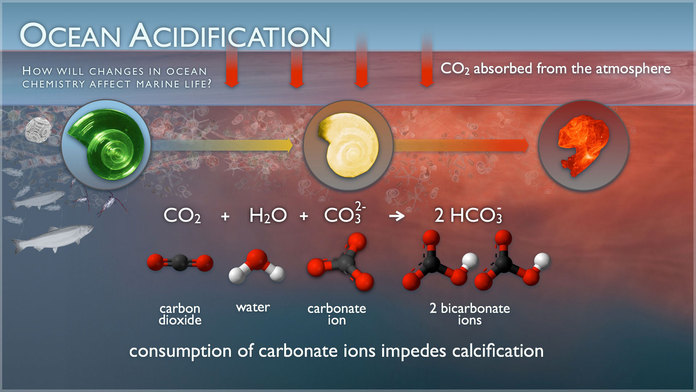
Ocean acidification has not yet been a major contributor to ocean problems but more and more studies have been focusing on this.  According to NOAA the ocean absorbs approximately a quarter of the Carbon Dioxide we release into the air every year.  As we discussed in class acidification of waters can happen through the reaction shown below and has the potential to hurt many habitats.  
Ocean Acidification Illustration
Since this is just recently becoming noticeable in the oceans first signs of effects on the wildlife are beginning to appear.  The most noticed problem is inability to form calcium carbonate structures, which has been effecting mostly corals and animal that secrete shells.  
In one study done at Oregon State University there was signs that acid environment during larval development of oysters lead to an inability to grow correctly and to low recruitment levels   This immediately has an affect on businesses using oysters and other shelled animals to make a profit, but will soon be noticeable in the environment.  The reduction of these animals may be an indication of future problems to come and act as a sort of "canary in the coal mine" for the ocean.   
Although the results of this ocean acidification have not been immediately evident there are beginning to be signs that it is affecting the wildlife.  Since there are calcium carbonate animals such as corals that are already being greatly reduced in numbers it is important the situation becomes controlled as soon as possible.  Also, since areas of upwelling will soon be bringing waters that were previously acidified the situation will not just get better on its own.  

References

Monday, April 26, 2010

Acidifying Oceans Dramatically Stunt Growth Of Shellfish

Research was done on the effects of increased acidic levels on growth of the Olympia oyster. Brian Gaylord, a biological oceanographer of the University of California at Davis, says that one-third of the world's human caused carbon dioxide emissions have entered the oceans. Increasing levels of carbon dioxide cause the seawater to become more acidic.
Gaylord is investigating the effects of this acidic change on the growth of larval and juvenile Olympia oysters on the west coast. He collected adult oysters from Tomales bay, California and kept them until they released larvae. The larvae were reared in one of three environments. The first matched current carbon dioxide levels which is 380 ppm. The second was 540 ppm and the third was 970 ppm. These levels are the estimated carbon dioxide levels for the year 2100.
At day 9, oyster juveniles in the high carbon dioxide treatment had shells that were 16% smaller than those reared in the control. At day 19, the results were more intense. Juveniles of the higher carbon dioxide treatment had grown 41% less than those of the control. Even after the high carbon dioxide treated oysters were placed into current water conditions for a month and a half, they were still 28% smaller.
The increasing levels of carbon dioxide in the oceans could have detrimental effects on the populations of oysters around the world. 85% of global shellfish reefs have been lost making it one of the most severely threatened marine habitats on the planet. These organisms are the engineers of bays and estuaries and with their loss will come the loss of whole ecosystems.

The article can be found here

Thursday, March 18, 2010

Oyster Reefs Invaded


The Olympian Oyster, commonly found on Tomales Bay in California, has begun to vanish due to humans moving certains species beyond their natural borders and habitats. Native and exotic species relationships may have an effort on the loss of critical habitats due to this discovery. David L. Kimbo, marine biologist and his colleagues from The Florida State University Coastal and Marine Laboratory are responsible for this discovery. The loss of this Olympian Oyster will be dramatic because they provide many settlement habitats for different species. With this study, the habitat management and conservation efforts in Florida will be more successful to help restore the oysters. The Atlantic Coast crabs and snails are the explanation for this oyster decline because of the predator-prey mismatch. The native and non native species being introduced has caused the oyster habitat to become interrupted, which has lead to decline. Kimbo and his team are planning to keep studying this interaction to try and protect those Olympian oysters.


  • Reading the full article will give a more detailed explanation of this oyster decline.

Olympian Oysters

  • Picture shows the Intertidal Zone of Tomales Bay in California, the oysters are present on the rocks.